William Sr. had two of his sons marry into the Woods clan: William Jr. Buster, his oldest, married Jane Woods, and John, his third son, married Elizabeth Woods. William's grandson, Claudius Woods Buster- son of John- married his first cousin, Isabella Woods.
The Woods had altered their name from du Bois, whose ancestors came over from France sometime during the late 16th century, to the Anglican version of the name, which translates to "Woods". They were a family who came from a long line of nobility which gave them access to land grants and marrying into other noble families from England and Scotland during the two centuries prior to their last journey to the New World. Historically, the Woods WERE NOT IRISH NOR FULLY SCOTTISH despite living in Ireland, much like the Buster Clan. The Woods originated from France, to Yorkshire, England and then had immigrated to Meath, Ireland. Before the Woods made this migration, a significant attempt to establish English control in Ireland began by Henry VII in 1494. When the English king dismissed the earl of Kildare from his post as lord deputy, and Henry VII sent Sir Edward Poynings in his place with a full contingent of English administrators. Poynings summoned a parliament at Drogheda in December 1494 which passed legislation to assert English supremacy, including the forbiddance of marriage between English colonists and the Irish. These acts, subsequently known as the Statutes of Drogheda (or more informally as Poyning's Law), remained in force until 1782.
Interesting contuer arugument about the myths regarding Tropper Woods, and the Woods linage. Click here for full document
When politics infringed on them finically, with taxes that were increased in the early 18th century during a series of droughts that harbored little profit, and infringed religiously, especially being surrounded by the Anglican and Catholic churches, the pragmatic Woods migrated to America, first arriving in Pennsylvania, then to the Shenandoah Valley, Virginia. It was in America that the Woods finally could marry outside of the English laws. Because of their background, the Woods were a prominent family who had dinned with Thomas Jefferson's family in Albemarle, County. But don't be fooled by their privileged background into presuming that were not a hardy group. Living on the American frontier they toiled to survive and fought for their beliefs. And although they were not the typical Scot-Irish, but their migration in America followed the trails of the Scot-Irish and even German migrations.
MICHAEL MARION WOODS:
He came to Albemarle County about 1734 and settled near Woods Gap, now called Jarman's Gap in the Blue Ridge Mountains. He received land patents for 1,300 acres near Lickinghole, Mechum's River and Beaver Creek, embracing the present Mechum's Depot and Blair Park. At the same time he also purchased 2,000 acres from Charles Hudson on Ivy Creek. The first Presbyterian Church as built at Mountain Plains and named for Michael's home. His remains were buried about 100 yards from his home; however, during the Civil War the stone was broken. A chip was found which confirms his birth date.
His will mentions 3 sons and 3 daughters: Archibald, John, William, Sarah (wife of Joseph Lapsley of Rockbridge), Hannah (wife of William Wallace) and Margaret (wife of Andrew Wallace). Sons Archibald and John were the executors.
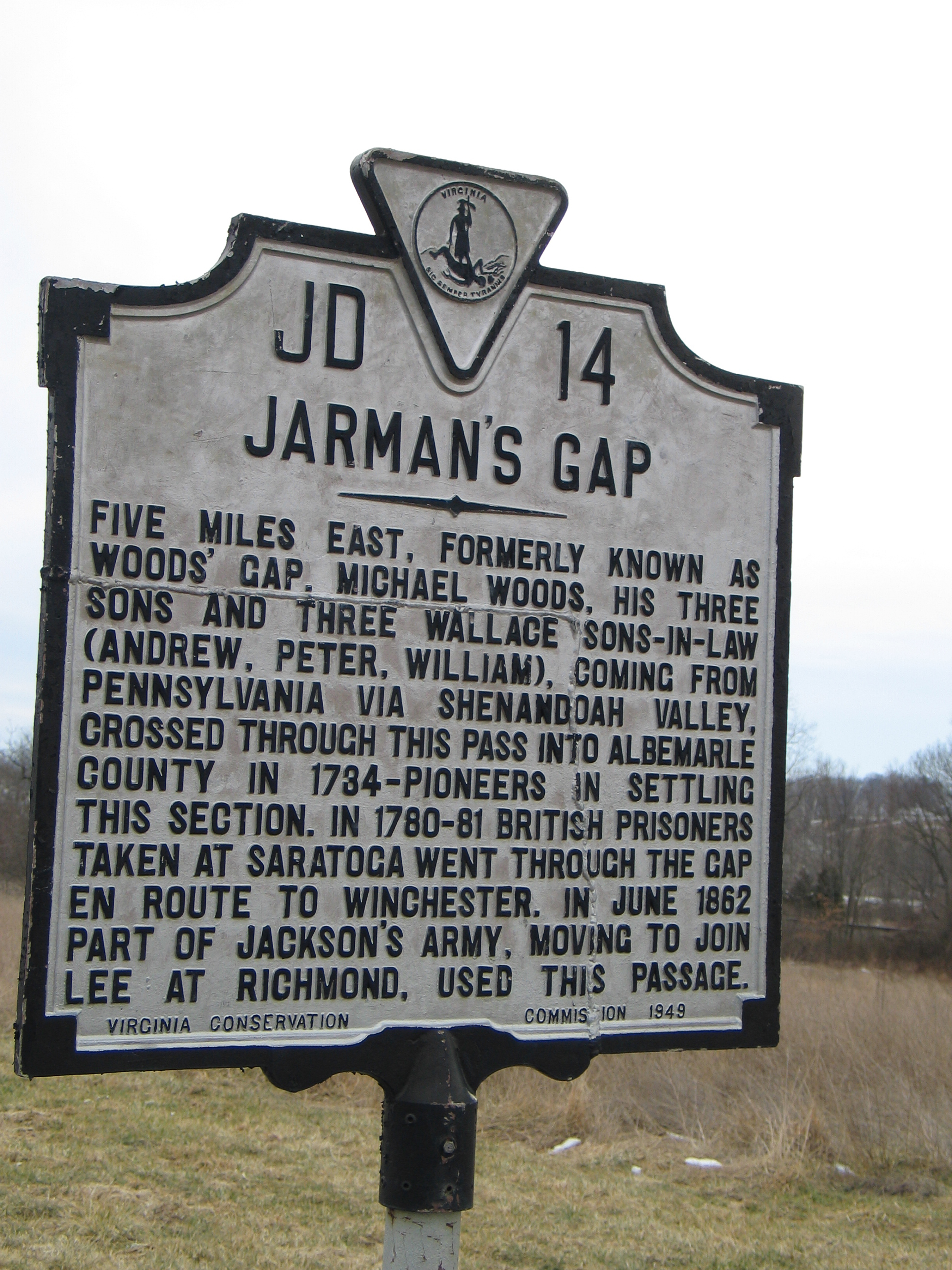
(JD14) JARMAN'S GAP
Five miles east is Jarman's Gap, formerly known as Woods' Gap. Through this pass Michael Woods, his three sons, and three sons in law (Andrew, Peter, William Wallace), coming from Pennsylvania via Shenandoah Valley, crossed into Albemarle County in 1734; pioneers in settling this section. In 1780 to 1781 British prisoners taken at Saratoga went through the gap en route to Winchester. In June, 1862 part of Stonewall Jackson's Confederate army, moving to join Lee at Richmond, crossed the mountain here. (Route 340, 1.2 miles north of Waynesboro).
From a book "Pioneer Strength, etc" page 26 is an account of the early Woods Family.
"The Woods family of Ireland in early 18th century became involved in a time of great movement. The family being dissenters and Presbyterians like many in the same place and time, longed to escape persecution and the religious bigotry of England. To make a new life in the American colonies became the dream in so many minds because it was a promise of freedom. This particular family named Woods are thought to be of pure English or Anglo-Scotch blood who, prior to 1650 were connected with the English Established Church. Life for them in Ireland was eventually unbearable. So it was that in 1742 did Michael Woods along with his brothers and sister set sail for the New World."
From "The Daily Progress" Charlottesville, Virginia, 1762-1962.
Michael Woods Led a Band of Settlers
Most of Albemarle's first settlers followed a gradual westward movement from the Tidewater. Mighty Michael Woods did not.
 |
| Jarman's Gap |
In 1734 this ancestor of countless local residents and scores of western pioneers brought a band across the Blue Ridge Mountains from the Valley of Virginia. They had come from Pennsylvania traveling over 200 miles and are believed to have been the first whites to come through Woods' Gap - now Jarman's Gap - by the old Indian trail. There were 25 or 30 of them. Michael's wife, Mary Campbell, his sons and his sons-in-law and their families. They took up large holdings from Greenwood to Ivy. In 1737 Woods entered a claim for 1,300 acres on Mechum River and Lickinghole Creek. He also purchased 2,000 acres on the head waters of Ivy Creek. Woods was born in the north of Ireland in 1684 and came to this country "sometime in the decade of 1720. Landing on the banks of the Delaware, he spent some years in Lancaster County, Pa., thence ascended the Valley of Virginia and crossed the Blue Ridge" His home was near the mouth of Woods Gap and there he was buried in 1762 in the family burying ground a short distance from the dwelling. His will mentioned six children, three sons and three daughters. Historians say there is evidence that there were four other children, two sons and two daughters.
Miss Mary Rawlings, in her books "Ante-Bellum Albemarle," wrote that the family was Scotch or Scotch-Irish, a family of education and refinement. One of Michael's daughters, Hannah, was married to William Wallace who settled on the Piedmont plantation in the Greenwood neighborhood. This land remains in the hands of the Wallace family. While many of the family descendants remained here, many more joined the westward movement. They went to the other areas of Virginia then being settled, and they went west and south-to Missouri, Kentucky, Mississippi, Tennessee and Ohio-where they were prominent in the early affairs and government of those areas. Of Michael Woods Home, Miss Rawlings wrote "the original name of the plantation was Mountain Plains, the Mountain Plains Church having been built on a part of the land and named in commemoration. "With the passing of the property to Chief Justice John Blair prior to 1788, the name of the home was changed and it has since been known as Blair Park."
CHRONICLES OF THE Scotch-Irish Settlement IN VIRGINIA EXTRACTED FROM THE ORIGINAL COURT RECORDS OF AUGUSTA COUNTY 1745-1800
AUGUSTA COUNTY COURT RECORDS. ORDER BOOK No. XXIV.
page 304
Samuel Smith vs. Beaty.--Mr. Michael Woods, formerly of Paxtunk, Pennsylvania. Account dated 1733. Thomas Renich, on 1st September, 1750, deposed: About 8 years ago, at his own house, he saw and spoke with said Smith and Robert Buchanan, the then Sheriff of Lancaster County. He heard Smith (then merchant at Connoy) say, &c., several accounts: Smith vs. James Cathey, 1737; Smith vs. Adam Thomson, 1736-7-8; Smith vs. William Robinson, 1739; Smith vs. Richard Woods, 1738; Smith vs. Mrs. Margaret McDowell, 1737; Smith vs. Mrs. Mary McDowell, 1737; Smith vs. Michael Woods, 1738-9; Smith vs. John Maxwell; Smith vs. Samuel Woods, 1734-5-8; Smith vs. Francis Beaty, 1735-6; Smith vs. John Christian, 1737; Smith vs. Robert Christian, 1733-4-5-6; Smith vs. Randell McDaniel; Smith vs. William Hutchinson; Smith vs. George Hutchinson. All sworn to by Samuel Smith, late of County of Lancaster, before a Justice, in Philadelphia, 13th October, 1743.
More About MICHAEL MARION WOODS:
Census: Bet. 1725 - 1726, Listed as paying tax in Donegal Twp., Lancaster Co., PA; tax rate of 2 shillings
Christening: 1684, Ulster, Ireland
Immigration: 1724, To Pennsyvania
Movement: 1732, To Virginia
Probate: Jun 1762, Albemarle Co., VA
Will: 24 Nov 1761, Albemarle Co., VA
Daughters of the American Revolution Magazine about Michael Capt "of Botetourt" Woods
More About MARY CAMPBELL:
Alt. Name: Margaret
Cause of Death (Facts Pg): Killed by Indians; the first white woman killed in the Shenandoah Valley
Christening: Cannongate, Edinburgh
Title (Facts Pg): Lady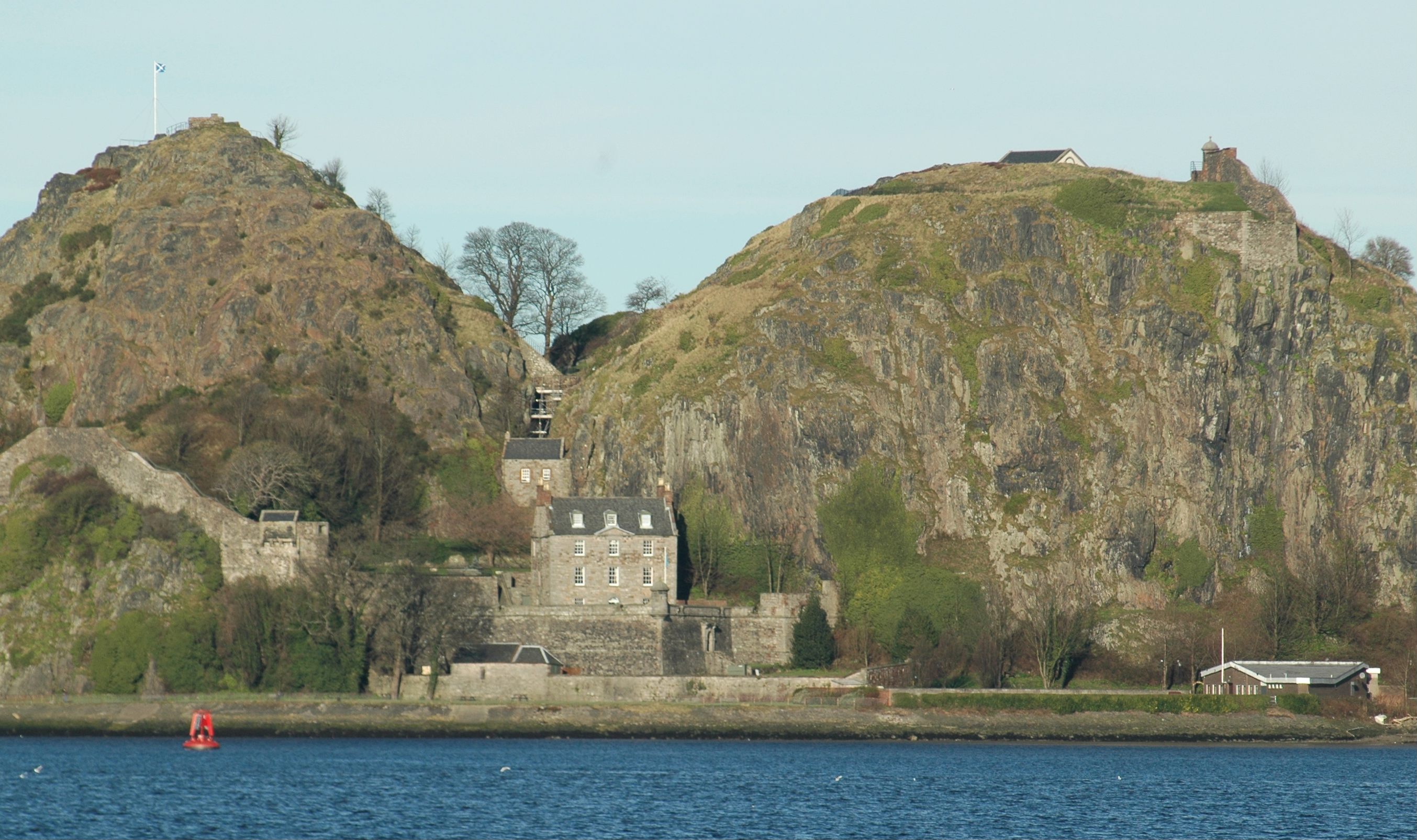 |
| Dunbarton Castle |
Sir James Campbell, the 3rd Baron of Auchinbreck, died in 1752, imprisoned in Dunbarton Castle for his part in the 1745 rising to restore the Stuarts. His will named daughters Elizabeth Woods and Mary Woods, as well as a Stuart daughter, and sons, including Gilbert Campbell. At least 6 of his children emigrated--for good reasons. The only reason the Baron didn't lose his head along with a large part of his lands in 1745/6, was because of his great age and thus because it could be claimed his mind had gone a little. However, he did forfeit the baronial seat--at Inveraray in Argyllshire, which is why these Campbells were sometimes referred to in their day as "of Argyll--meaning the location." Since it had originally come to the Auchinbreck line by grant of their superior lord the REAL "Argyll (Lords of Lochawe who became Earls of Argyll), it was forfeited back to the by then Duke of Argyll.
For about 300 years, however, Inveraray had been the property of the lairds, then baronets, then Barons of Auchinbreck and the last three generations of that line were closer to Cawdor than to Argyll. Peter Wallace's mother was Elizabeth Woods married to SAMUEL Wallace--not Peter Wallace Sr.--there was NO earlier Peter Wallace who was a father of the Peter Wallace of Rockbridge County. He is NEVER listed as "Jr." in either the Maryland, Pennsylvania or Virginia records. He and his brother Adam, were living in Cecil County, Maryland when Capt. Samuel Wallace, sea captain and merchant made his last voyage between Baltimore, Philadelphia, and Irish ports--and Glasgow (he made several voyages among these places in the 1720's) in 1725.
 |
| Dunshaughlin Castle in Meath, Ireland |
There is a record for Martha Woods being married in 1739 in Lancaster County, PA but no record for younger sister Sarah, which supports an Augusta County record in which it is implied that Sarah married Joseph Lapsley in Virginia in about 1741. Since Augusta County was not formed until 1745, and Albemarle was formed only the year before that, the marriage probably was in the early Orange County or Goochland County records. To carry this all a bit further. Michael, Samuel and Elizabeth Woods--and several other brothers and one more sister, were all children of Sir John Woods and his cousin--Elizabeth WOODS, of Dunshaughlin (note the spelling--the parish still exists in County Meath) Castle in County Meath. It was Elizabeth Woods who inherited the castle--from her parents Sir Thomas Woods and Elizabeth PARSONS.
More About MICHAEL WOODS and MARY CAMPBELL:
Marriage: 1704, Scotland
Children of MICHAEL WOODS and MARY CAMPBELL are:
19. i. MAGDALENA6 WOODS, b. 1706, Castle Dunshauglin, Ireland; d. 1810, McDowell Family Cemetery, Timber Ridge, Albemarle Co., VA.
20. ii. ARCHIBALD WOODS, SR., b. 11 May 1706, Castle Dunshauglin, Meath, Ireland; d. 1783, Roanoke Co., VA.
21. iii. MICHAEL WOODS, JR., b. Bet. 1709 - 1719, Dunshauglin Castle, Meath, Ireland; d. 11 Mar 1777, Buchanan, Botetourt Co., VA.
22. iv. HANNAH WOODS, b. 1710, Castle Dunshauglin, Meath, Ireland; d. Greenbrier, Albemarle Co., VA.
23. v. JOHN WOODS, b. 19 Feb 1711/12, Castle Dunshauglin, Meath, Ireland; d. 14 Oct 1791, Albemarle Co., VA.
vi. GEORGE WOODS, b. 1713, Dunshauglin Castle, Ireland.
24. vii. MARGARET WOODS, b. Bet. 1714 - 1720, Dunshauglin Castle, Meath, Ireland; d. Bet. 1756 - 1761, Thornhill, Albemarle Co., VA.
25. viii. WILLIAM WOODS, b. 02 Nov 1715, Castle Dunshanglin, Meath, Ireland; d. 12 Apr 1783, Greenbrier Co., VA.
26. ix. SAMUEL WOODS, b. 1718, Castle Dunshanglin, Meath, Ireland; d. 11 Mar 1777, Buchanan, Botetourt Co., VA.
27. x. CHARLES WOODS, b. Abt. 1719, Ireland; d. Bef. May 1761, Rockbridge Co., VA.
xi. ROBERT WOODS, b. 1719, Castle Dunshanglin, Ireland; d. 1779, Buffalo Creek, Augusta, GA.
28. xii. MARTHA WOODS, b. 1720, Dunshaughlin Castle, Meath, Ireland; d. 1790, Thornhill, Rockbridge Co., VA.
29. xiii. RICHARD WOODS, b. 1721, Meath, Ireland; d. Bet. Mar - Apr 1778, Buffalo Creek, Augusta Co., VA.
30. xiv. ANDREW WOODS, b. 1722, Castle Dunshauglin, Meath, Ireland; d. 1781, Botetourt Co., VA.
31. xv. SARAH WOODS, b. 1724, Castle Dunshanglin, Meath, Ireland; d. 1792, Greenbrier Co., VA.
Notes for WILLIAM WOODS:Took an active part in the Colonial wars, holding the rank of Colonel. (Mary Kinney research notes, 8/04/99)
Served a a private in Capt. George Gibson's company, Albemarle Co., Virginia troops. (From DAR ID No. 117679)
He received military land grants in Greenbrier Co., VA, Madison Co., KY and some in Scioto, OH. Five of his sons were commissioned in the Revolutionary War. (Source: "Wallace", by George Selden Wallace, Michie Co., Charlottesville, VA 1927)
More About WILLIAM WOODS:
Alt. Birthdate: 1705
Movement: In 1758 moved from Albemarle Co., VA
Occupation: Lieutenant in the frontier Indian wars
Probate: 16 Apr 1782, Greenbrier Co., VA
More About WILLIAM WOODS and SUSANNA WALLACE:
Marriage: 1732, Lancaster Co., PA
Children of SUSANNA WALLACE and WILLIAM WOODS are:
i. SUSANNAH7 WOODS, d. Died in childhood.
40. ii. ADAM C. WOODS, SR., b. 12 Aug 1742, Greenbrier Co., WV; d. 04 Aug 1826, Howard Co., MO.
41. iii. MARY WOODS, b. 14 Apr 1744, Albemarle Co., VA; d. 1810, Lincoln Co., KY.
42. iv. WILLIAM WOODS, b. 31 Dec 1744, Albemarle Co., VA; d. 1837, Albemarle Co., VA.
43. v. MICHAEL WOODS, b. 1746, Greenbrier Co., WV; d. 03 Jul 1809, Madison Co., Kentucky.
44. vi. JOHN WOODS, b. 1751, Albemarle Co., VA; d. 16 Oct 1815, Franklin Co., TN.
vii. ANDREW WOODS, b. 1753, Blair Park, Albemarle Co., VA; d. 1813, Franklin Co., Tennessee26; m. HANNAH REID27, Kentucky; b. 1754, Virginia; d. 10 Jul 1835, Franklin Co., TN28.


